

1 Killing site(s)
Sofia B., born in 1930: "Before the war, there were many Jews here; all the houses in the town center belonged to Jewish families. I knew many of the Jews in the camp. When they returned from work, they would stop by villagers’ houses to ask for something to eat, because they were starving. They came to our house as well, and we gave them whatever we could; we understood how hungry they were.
When the camp was liquidated, some of the young people managed to escape through the windows of the barracks and took refuge in the nearby forest. After that, the Germans set fire to the barracks, burning alive all those who remained inside. Those young people survived and now live in Israel. They come to pay their respects at the graves of their parents, who were killed here." (Testimony N°YIU52U, interviewed in Sasiv, on July 26 2004)
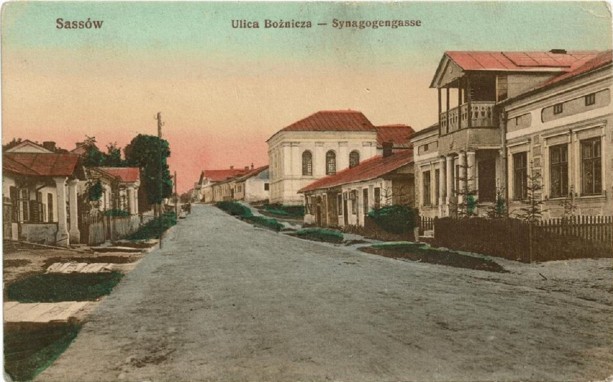
Sasiv is a town in the Lviv region, situated 8 km (5 mi) from Zolochiv and roughly 70 km (43 mi) east of Lviv. It was granted a town charter in the early 17th century, with its foundation traditionally dated to 1615. Before 1939, it was part of Poland.
Jews have been present in Sasiv since the early modern period, and the Jewish population is documented from the 18th century onward. A census conducted in 1764 recorded 223 Jews. Later statistics indicate 1,906 Jews in 1880; 1,761 Jews, representing 52.1% of the town’s population, in 1912; and 1,096 Jews (35.4%) in the 1921 census. The decline in the Jewish population recorded in 1921 was caused by emigration to the United States and by World War I. These figures demonstrate that Sasiv was a significant Jewish center in the region throughout the late 19th and early 20th centuries. The Jewish community also maintained its own cemetery.
Sasiv was also a recognized Hasidic center. The Sasov Rebbe, Moshe-Leib, widely cited in Hasidic sources, underscores the town’s religious and spiritual importance in regional Jewish life.
Economically, Jews in Sasiv were engaged in a variety of crafts and small-scale industries. Notably, the town was internationally renowned for producing ornamental strips for prayer garments, and its residents also participated in the trade of alcoholic beverages.
Like much of eastern Galicia, Sasiv underwent significant geopolitical changes between 1939 and 1941. Following the advance of the Red Army in September 1939, the town came under Soviet control. During this period, private property was abolished and religious life was restricted, affecting Jews as well as other religious communities. Sasiv remained within the Soviet sphere until the German invasion of June–July 1941.
According to the last pre–Second World War demographic records from the late 1930s, the Jewish population of Sasiv numbered approximately 1,500 residents.
Sasiv was occupied by German forces in July 1941.
According to local sources, 22 prominent Jews, accused of being communists, were shot by German forces within two weeks of their arrival in the town.
Between July 1 and July 18, 1941, nearly 65 Jews were killed in the town in three separate groups.
Under German occupation, the Jewish population of Sasiv was subjected to ghettoization, forced labor, deportation, and mass murder, in line with the broader persecution carried out across the Galician district.
A forced labor camp for Jews operated in Sasiv from 1941 to 1943, holding approximately 250 prisoners who were employed in a quarry owned by the Radebeul company. The women’s section of the camp opened in August 1941, followed by the men’s section in November 1941. In July 1942, some young Jews from Zolochiv were transferred to the camp.
The first deportation Aktion took place in mid-1942, though sources differ on the exact date. Some indicate July 15 or August 29, while others record September 12, 1942, during the celebration of Rosh Hashanah. On that day, nearly 100 Jews from Sasiv were deported to the Bełżec killing center, while those deemed weak or disabled were killed on the spot.
On November 25, 1942, a number of Jews from Sasiv were sent to the Zolochiv Ghetto alongside Jews from surrounding towns.
A week earlier, notices were posted in the streets of Sasiv ordering the Jewish population to relocate to the Zolochiv Ghetto within one week. Only workers of the Sasiv Jewish forced labor camp were exempt from this order, but this exemption did not extend to their families. Later that year, these workers were also among those deported from the district to Bełżec. Local testimony and memorial sources indicate that Jews sent from Sasiv to Zolochiv never returned, and that substantial numbers perished during deportations to Bełżec, including the one carried out in April 1943 during the liquidation of the ghetto.
The forced labor camp in Sasiv continued to operate with approximately 400 inmates. Sofia B., born in 1930, recalled seeing the Jews being taken to work. According to her testimony, when they returned from work they were sometimes able to stop at local residents’ homes to ask for food.
In April 1943, approximately 70 Jews escaped from the Brody Ghetto. They were members of a clandestine organization established by Yakov Linder and Shmuel Weiler, which coordinated attacks on ghettos and forced labor camps with the aim of liberating Jewish prisoners. One of their successful operations was a raid on the labor camp in Sasiv. Following a revolt, the camp was liquidated on July 18 or July 23, 1943, though some sources report that it occurred in August.
Accounts differ regarding the fate of the remaining prisoners. While some sources state that they were killed in the nearby woods and the barracks burned, Sofia B., born in 1930, recalled that the Jews were killed at the Jewish cemetery in Sasiv. She remembered hearing them being brought there and lamenting, and witnessing the camp being set on fire in order to flush out the last Jews in hiding.
Today, there is no official memorial at the Jewish cemetery commemorating the victims. According to Sofia, however, survivors and descendants of those killed during the camp’s liquidation regularly visit the site to pay their respects.
Do you have additional information regarding a village that you would like to share with Yahad ?
Please contact us at contact@yahadinunum.org
or by calling Yahad – In Unum at +33 (0) 1 53 20 13 17