1 Killing site(s)
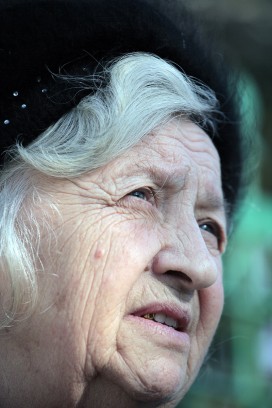
Nalia S., born in 1937: "When the Germans arrived, they ordered all non-German residents to relocate to surrounding villages. My mother, who was Ukrainian, had to leave for a neighboring village, while my brother and I stayed in Stavky with our paternal grandmother, who was German.
One day, I remember the weather was still mild, perhaps in autumn, a very long column of Jews was brought here by force. There were whole families: adults, elderly people, and children. Probably due to the lack of a large building where they could all be accommodated together, several Jewish families were put in each house in the village for a brief stopover. There were ten or twenty Jews in our house, quite a large number. Late in the evening, when I was already asleep, they were taken away. I woke up because of the bursts of gunfire that could be heard. The shooting went on for a long time, but by morning everything was over.
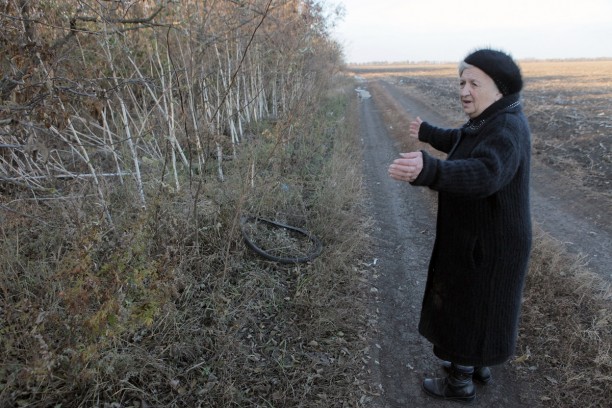
The next day, we learned that the Jews had been taken to a bomb crater from the beginning of the war and shot. The village’s only Jewish family was killed alongside the other Jews at the same site.” (Testimony N°YIU1286U, interviewed in Stavky, on November 6, 2011)
" […] Shortly after the occupation, a SD commando, consisting of one to four people, took up quarters here. […] This commando was also active in neighboring villages. […] As I recall, the SD commando stayed on site for about 14 days and then left. Afterwards, the only Reichsdeutscher here was the head of the MTS. […] As soon as the SD commando arrived on site, a Selbstschutz unit was established. All men fit to bear arms were ordered to gather one day at the burgmestre (mayor’s) office. […]
Regarding these events, I can say that I was designated for guard duty one night. […] I believe it was in the autumn, after the harvest. I had already heard that on that day, Jews had been brought into the church. I cannot state the number of Jews, as I did not count them. When I entered the guard house, I was told that I was to guard the front of the church. […] During my guard shift, I did not speak to the Jews and did not know what was going to happen to them. The room inside the church where the Jews were held was locked. We did not have the key to this room. Another afternoon, we were once again ordered to perform guard duty. In the meantime, new Jews had been brought there. Karl R. and I, along with two other members of the Selbstschutz, received the order to expand existing clay pits behind the cemetery. […] At that moment, it became clear to me that the Jews were going to be shot. Indeed, it had previously been said that the Jews were going to work. […] Schuler was present when we expanded the pit. The pit measured 3x3 meters and was 2 meters deep. Schuler had said that in the evening they would begin "taking the Jews to work."
I first heard about the shooting of the Jews from Wilhelm F. He had been designated to escort the Jews to the pit with a weapon. According to his account, a resident of Waterloo was required to provide a vehicle to transport the Jews. The shootings began at sunset. As darkness fell suddenly, the shootings were halted and resumed the following morning. According to Wilhelm F.’s account, no member of the Selbstschutz was deployed as a shooter during the execution. The shootings were carried out by the men of the SD. […]
Shortly after the execution, a Jewish family with two children was still living in our village. They had escaped the execution. Betz returned with his commando and shot the couple along with the children at the same site where the previous executions had taken place. […] " [Deposition of Friedrich MANN, Volksdeutsche, member of the Selbstschutz in Waterloo. Taken in Hanover on January 14, 1971; BArch162-2314, p.26]
Stavky is a small village in the Mykolaiv region, situated approximately 40 km (25 mi) south of Voznesensk. Founded in 1819 as the German colony of Waterloo, the village was established by ethnic German Protestant settlers, predominantly from Württemberg. Following the 1917 Revolution and the creation of the Soviet Union, Waterloo was incorporated into the Karl-Liebknecht German National District between 1925 and 1939. This administrative unit was designed to grant cultural and linguistic autonomy to the local Volksdeutsche population. Nalia S., born in 1937, whose father was ethnic German, remembers the village school where instruction was provided in German.
Prior to 1941, Waterloo was predominantly a German village, though it was also home to Russians, Ukrainians, Roma, and a local Jewish family. A few non-resident Jewish families also worked at the village’s Machine and Tractor Station (MTS), though they left at the outbreak of the war.
The German presence in Waterloo came to an end in 1944 when the ethnic German population was evacuated westward by German soldiers ahead of the Red Army’s advance. In the aftermath of the war, as part of Soviet anti-German renaming policies, the historic village of Waterloo was officially renamed Stavky in 1946.
Stavky was occupied by German troops in August 1941. Like other settlements in this part of the Mykolaiv region located west of the Southern Bug River, the village subsequently came under Romanian administration as part of the Transnistria Governorate. Nevertheless, as an ethnic German colony, it remained under the strong influence and direct control of German authorities. Yahad - In Unum witness Nelia S., born in 1937, recalled a German commander stationed in Stavky. This detail is corroborated by German archival records, which document a Reichsdeutscher heading the local Machine and Tractor Station (MTS). Archives also indicate that an SD unit was stationed in the village for at least two weeks, operating across neighboring settlements, and that a local Selbstschutz (self-defense) unit was formed from the ethnic German population.
One day, likely in the autumn, a large column of Jews, including entire families with children, was brought to Stavky and confined in the local church under guard. According to Nelia S., however, local residents were also required to temporarily house several Jewish families in their yards for the day, likely because no single structure was large enough to detain everyone together. Shortly thereafter, in the evening, all the Jews, including a local Jewish family, were marched to the outskirts of the village and shot by members of the SD unit.
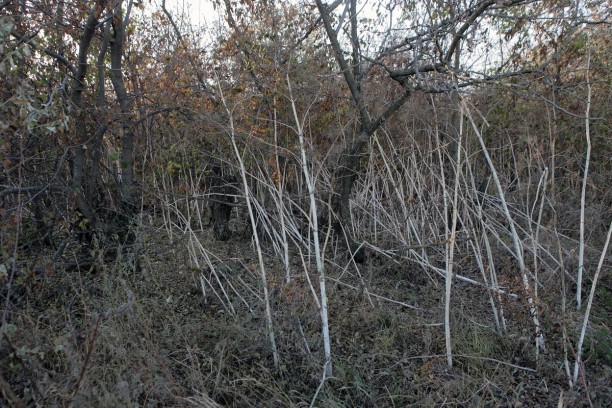
Archival depositions indicate that the shooting occurred in a clay pit, which the witness identified as the location of a bomb crater. Nelia S. recalled hearing sustained bursts of gunfire throughout much of the night. The killing site was covered immediately after the shooting, as local residents and children who visited the area the following day found the pit already filled with earth. The victims’ remains rest there to this day. Today, the killing site is overgrown with vegetation and lacks any memorial.
Do you have additional information regarding a village that you would like to share with Yahad ?
Please contact us at contact@yahadinunum.org
or by calling Yahad – In Unum at +33 (0) 1 53 20 13 17