1 Killing site(s)
Pavlo K., born in 1928 : "Before the war, there were about 900 Jews here. They lived mainly in the town center. They represented a wide social spectrum, ranging from wealthy merchants to very poor families who survived by begging or by collecting rags in neighboring villages. Many shops were owned by Jews, and some families owned livestock or land. I also remember a Jewish pharmacist, Viktor Rotbach.
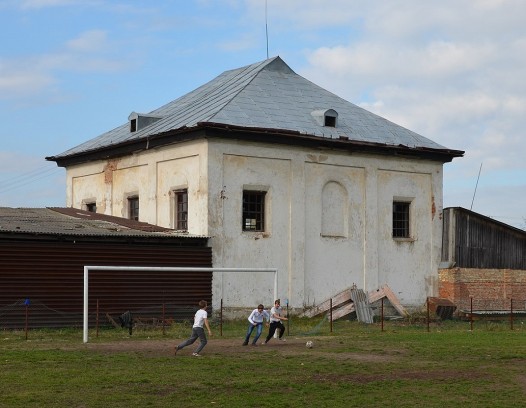
The Jews were very religious, and the Jewish community had three synagogues. Today, only one remains. There was no separate Jewish school. Jewish children attended the same schools as Ukrainian and Polish children, except on Saturdays, when they studied their language at the synagogue.
When the Germans arrived, they did not immediately target the Jews. I remember that Viktor Rotbach’s pharmacy continued to operate for quite some time. Problems for the Jews began in 1943. One night, the Germans organized a roundup and captured Jews wherever they could find them, gathering them at the Judenrat. During the roundup, we were not allowed to go outside, but my friends and I were curious and sneaked out to watch. We could hear the Jews who were caught being beaten and mistreated.
The Jews were then gathered in the market square and transported by cart to the Busk ghetto. There was a Jewish police force that helped keep the Jews assembled in the market square. They wore armbands with a star. When the roundup was over, they too were taken away and suffered the same fate as the others.
A month later, the remaining Jews were shot here. First, they were forced to dig their own graves. Then they were made to lie face down in the graves and were shot. There was only one grave, about two meters deep. Afterward, local men were ordered to fill it in. From the top of a wall, some friends and I watched as they threw earth into the grave." (Testimony N°YIU391, interviewed in Toporiv, on August 31 2006)
Toporiv is a town in the Lviv Region, situated approximately 20 km (12.4 mi) from Busk. It was founded in 1603 and quickly developed into a local economic center in eastern Galicia. Jewish settlement began at the town’s foundation and benefited from relatively favorable privileges, allowing a structured and economically active community to emerge despite occasional violence and destruction, notably during the Russian occupation of 1914–1915, when houses were looted and destroyed by Cossack units.
The Jewish cemetery was established in the second half of the 17th century. During World War I, it was vandalized and the tombstones were used as building material.
From the 17th through the 19th century, the Jewish population grew steadily and reached its peak in the late 19th century. According to census data, in 1880 the town had 3,460 inhabitants, including 1,133 Jews; in 1900, 4,421 inhabitants, including 1,400 Jews. Jews thus constituted roughly one quarter of the population and played a central role in local economic life, particularly in trade, crafts, pottery production, and the timber trade.
By the interwar period the Jewish population had declined sharply. In 1921, Toporiv had 3,421 inhabitants, of whom 689 were Jews, reflecting the impact of war, economic hardship, fires, and emigration.
The Jewish community developed a strong Hasidic character, with multiple synagogues and prayer houses connected to various Hasidic courts.
With the establishment of Soviet rule in 1939–1940, the town’s social and economic conditions were fundamentally altered. Private businesses were largely eliminated, forcing many residents to seek employment with the local council or within state-run cooperatives. In 1939, a state school was opened in which Yiddish served as the primary language of instruction. During this period, Jews continued to play a prominent role in the cultural life of the town.
Toporiv was occupied by Wehrmacht units on June 24 1941. Jews were immediately seized in public, including Rabbi Meshulam Zalman Zilberfarb, and confined in the Great Synagogue, where they were subjected to abuse by German soldiers and local collaborators. On June 26, 1941, with German approval, Ukrainian auxiliary forces carried out a massacre, during which approximately 180 Jews were captured in the streets, taken to a nearby forest, and shot; additional victims were subsequently added to the same mass grave.
In early July 1941, a Judenrat (Jewish council) was established under the leadership of Yaakov Wolfert. A small group of Jews was assigned supervisory functions within the community. The Judenrat was compelled to cooperate with the German authorities by supplying forced laborers and facilitating the confiscation of Jewish property. Jews were forbidden to leave the town under threat of death. According to historian Ilya Altman, a further approximately 120 Jews were shot in September 1941.
From late 1941 onward, Jewish youths were sent to forced labor camps in Palohov and in the Ternopil region. Further deportations followed.
According to several sources, in March 1942 approximately 90 Jews were deported together with local non-Jewish residents to the Bełżec killing center. By contrast, Ilya Altman indicates that during the same month approximately 100 Jews who were considered too weak were shot in Toporiv.
Another Aktion, carried out in September 1942, led to the deportation of at least 120 Jews, although one source estimates the number of deportees to be as high as 200. In November 1942 (or December 2, 1942, according to other sources), further deportations sent several hundred Jews – approximately 700 according to Ilya Altman - to the Brody Ghetto.
In February 1943 the remaining Jews of Toporiv, approximately 110 individuals, were deported, presumably to Bełżec. According to the testimony of Pavlo K., born in 1928 and interviewed by Yahad–In Unum, the Germans organized a nighttime roundup in early 1943, during which Jews were seized throughout the town and assembled at the Judenrat. From there, the detainees were gathered in the market square and transported by cart, presumably to the Busk Ghetto. Pavlo K. also recalls the presence of a Jewish police unit, identifiable by armbands bearing a star, which assisted in maintaining order; its members were deported together with the rest of the Jewish population. Only a small number of individuals managed to escape the roundup and join Soviet partisan units.
According to Pavlo K., approximately one month later a group of Jews were killed in a forest north of Toporiv, near a high-voltage power line tower and a road. The victims were forced to dig a single pit about two meters deep, ordered to undress, made to lie face down, and then shot. Local civilians were subsequently compelled to fill in the pit, a process that reportedly lasted several hours.
After the liberation of the town in the spring of 1944, several survivors initiated legal proceedings against local collaborators who had participated in the persecution and murder of Toporiv’s Jews.
In total, more than 1,000 Jews from Toporiv perished during the war. Of these, approximately 400 were shot in Toporiv, according to the estimations of Ilya Altman; more than 300 were deported to the Bełżec killing center, according to some sources; and several hundred were sent to the Brody Ghetto, where they subsequently shared the fate of the local Jewish community.
For more information about the killings of Jews in Brody please refer to the corresponding profile.
Do you have additional information regarding a village that you would like to share with Yahad ?
Please contact us at contact@yahadinunum.org
or by calling Yahad – In Unum at +33 (0) 1 53 20 13 17